
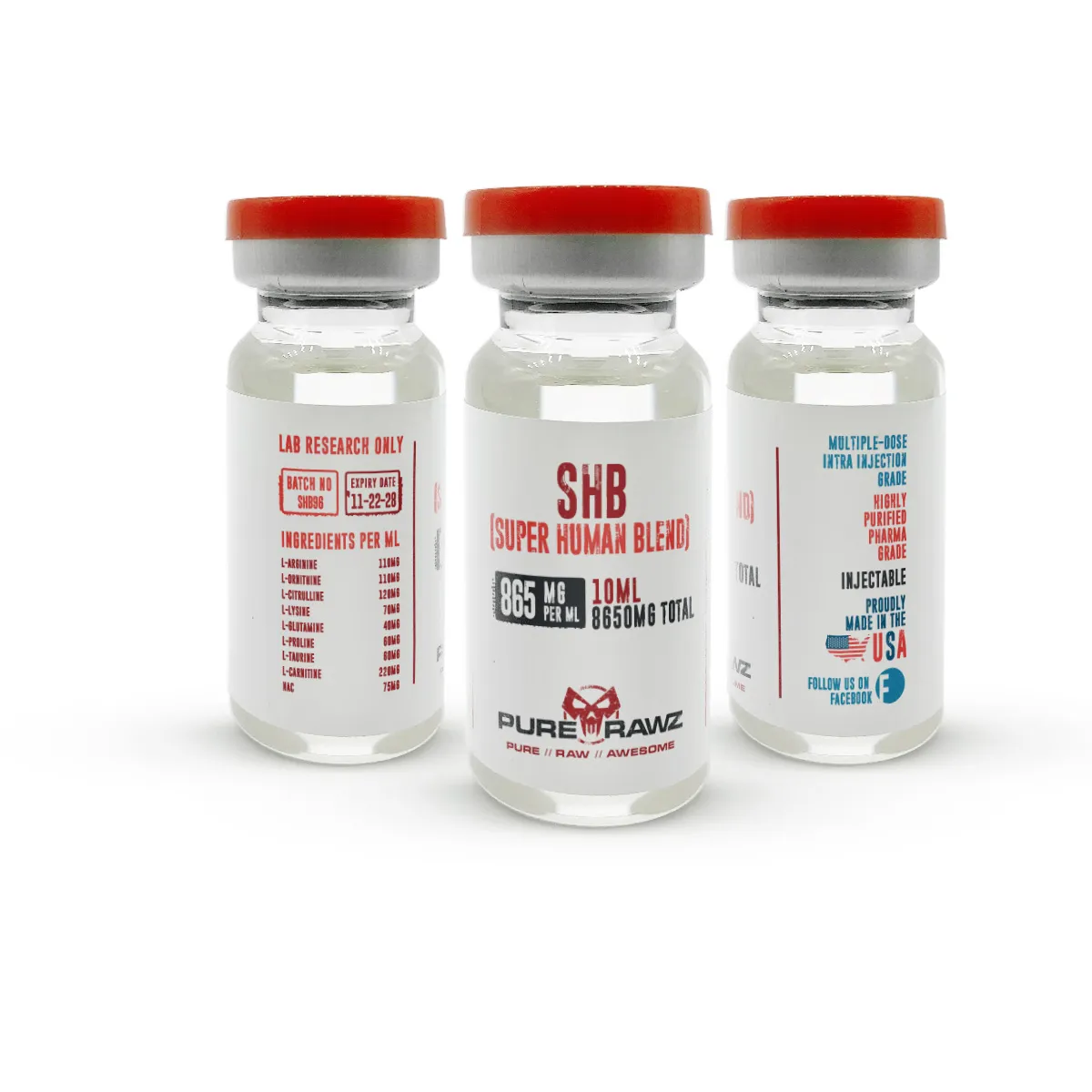
SUPER Human Blend (SHB)
$78.00
Note: We recommend using sterile Bacteriostatic Water for reconstitution.
Overview
SUPER Human Blend (SHB) is a nine-component free-form amino acid and amino acid derivative research blend formulated as an injectable solution providing 865mg total per vial. Components include L-arginine (110mg), L-ornithine (110mg), L-citrulline (120mg), L-lysine (70mg), L-glutamine (40mg), L-proline (60mg), L-taurine (60mg), L-carnitine (220mg), and N-acetyl cysteine (NAC, 75mg). None of the nine components is a peptide — all are individual free-form amino acids or amino acid derivatives without peptide bonds between them — and none interacts with androgen receptors. The blend is classified as a free-form amino acid complex targeting nitric oxide, urea cycle, antioxidant, and mitochondrial research pathways. Supplied for laboratory research only.
Chemical Properties
| Property | Details |
| Product Format | Injectable research blend | 10mL vial | 865mg total per vial |
| Compound Class | Free-Form Amino Acid/Antioxidant Complex | NOT a peptide | NOT a SARM |
| Component 1 | L-Arginine | CAS 74-79-3 | 110mg/vial | MW 174.20 |
| Component 2 | L-Ornithine | CAS 70-26-8 | 110mg/vial | MW 132.16 |
| Component 3 | L-Citrulline | CAS 372-75-8 | 120mg/vial | MW 175.19 |
| Component 4 | L-Lysine | CAS 56-87-1 | 70mg/vial | MW 146.19 |
| Component 5 | L-Glutamine | CAS 56-85-9 | 40mg/vial | MW 146.15 |
| Component 6 | L-Proline | CAS 147-85-3 | 60mg/vial | MW 115.13 |
| Component 7 | L-Taurine | CAS 107-35-7 | 60mg/vial | MW 125.15 |
| Component 8 | L-Carnitine | CAS 541-15-1 | 220mg/vial | MW 161.20 |
| Component 9 | N-Acetyl Cysteine (NAC) | CAS 616-91-1 | 75mg/vial | MW 163.20 |
| Physical Form | Clear aqueous injectable solution |
| Purity | ≥98% per component (HPLC verified) |
| Storage | Refrigerate at 2–8°C; protect from light; do not freeze |
| Classification | Research Use Only (RUO) |
Mechanisms Investigated in Preclinical Research
Arginine-Ornithine-Citrulline → Urea Cycle and Nitric Oxide Pathway: L-Arginine, L-ornithine, and L-citrulline are three sequential intermediates in the urea cycle, investigated in hepatocyte and vascular endothelial cell models for their roles in nitrogen disposal and NO production. L-Arginine is the obligate NOS substrate; L-citrulline is the NOS co-product, which is recycled to arginine via argininosuccinate synthase (ASS) and argininosuccinate lyase (ASL); L-ornithine is the urea cycle intermediate produced by arginase. In vascular endothelial cell models, the arginine-citrulline-NO axis has been investigated for NO bioavailability, eNOS substrate limitation, and arginine recycling efficiency. Data suggests citrulline may more reliably elevate plasma arginine availability than arginine supplementation directly due to intestinal metabolism differences.
NAC → Glutathione (GSH) Precursor and Nrf2 Pathway: N-Acetyl Cysteine (NAC) is investigated in cell model research as the rate-limiting cysteine precursor for glutathione (GSH) biosynthesis. GSH is the principal intracellular antioxidant, regenerated from GSSG by glutathione reductase (GSSGR) using NADPH. NAC also directly scavenges reactive oxygen species and has been investigated for NF-κB inhibition and Nrf2-ARE antioxidant response element activation in oxidative stress cell models.
L-Carnitine → CPT-1 Fatty Acid Transport (dominant by mass): At 220mg/vial, L-carnitine is the highest-mass component. The CPT-1/CACT/CPT-2 mitochondrial fatty acid transport mechanism is investigated in preclinical models as documented in Longo et al. 2016 (PMID 26828774). In skeletal muscle cell models, carnitine availability is investigated as a regulator of fatty acid oxidation vs glucose oxidation partitioning.
Research Applications
- Arginine/citrulline/ornithine NO and urea cycle pathway flux studies in primary vascular endothelial cells and hepatocyte models
- NAC/GSH redox capacity investigation: glutathione synthesis rate, GSH: GSSG ratio, and Nrf2 pathway activation in oxidative stress cell models
- Multi-pathway amino acid crosstalk research: interaction of urea cycle, glutathione synthesis, and fatty acid oxidation pathways in complex cell model systems
- CPT-1 substrate saturation kinetics at high carnitine availability (220mg/vial) in isolated mitochondria and permeabilized cell preparations
- Analytical chemistry method development for simultaneous HPLC quantification of nine co-dissolved amino acids in injectable research matrices
Risk & Handling
Handling Precautions
- Trained laboratory personnel only. PPE: nitrile gloves, laboratory coat, eye protection minimum
- High total concentration (865mg/vial) requires careful pipetting; avoid aerosol generation during transfer
Exposure Risks
- Risk Tier: MODERATE — nine essential amino acids/derivatives at high research concentrations. NAC at high concentrations may produce thiol-related oxidative stress modulation in sensitive cell model systems. No human safety data have been established for this specific injectable co-formulated blend at research concentrations. Data remains limited.
Storage
- Refrigerate at 2–8°C; protect from light. Do not freeze. NAC is oxidation-sensitive; minimize headspace air exposure. Stable ≥24 months under recommended conditions.
Quality Assurance
- Identity confirmation by nuclear magnetic resonance (NMR) spectroscopy and/or mass spectrometry (MS)
- Purity ≥98% by high-performance liquid chromatography (HPLC)
- Moisture content tested per USP standards where applicable
- Microbial testing for aerobic bacteria, yeast, and mould per USP <61> and <62>
- Heavy metals analysis (Pb, Cd, As, Hg) per USP <232>/<233> standards
- Full batch traceability with unique lot number documentation
- Certificate of Analysis (COA) available upon request for every batch
- Safety Data Sheet (SDS) available for all products
Why PureRawz
PureRawz supplies SUPER Human Blend (SHB) as a rigorously tested research-grade compound. Each batch undergoes independent third-party identity confirmation by NMR and HPLC, with purity ≥98% verified. Where supplier specifications for complex blends or novel fusion compounds vary across vendors, PureRawz applies batch-specific molecular identity confirmation to verify component presence and ratio accuracy. A Certificate of Analysis (COA) documenting identity, purity, and lot traceability is available for every batch. A Safety Data Sheet (SDS) is provided for all products. Researchers requiring absolute certainty on batch composition for publication-quality study design should request COA documentation before initiating protocols.
References
- Longo N, Frigeni M, Pasquali M. Carnitine transport and fatty acid oxidation. Biochimica et Biophysica Acta. 2016;1863(10):2422–2435. https://purerawlab.com style=”font-weight: 400″> [PMID 26828774]
- Chandler TL, White HM. Choline and methionine differentially alter methyl carbon metabolism in bovine neonatal hepatocytes. PLoS ONE. 2017;12(2):e0171080. https://purerawlab.com style=”font-weight: 400″> [PMID 28192459]
Disclaimer: Preclinical and published scientific research indicates potential mechanisms of action for this compound in laboratory and animal models. Any references to published studies are for informational purposes only and do not constitute a claim that this product produces the same effects in humans. The safety and efficacy of this compound in humans have not been established.
ATTENTION: All products sold by PureRawz are intended for laboratory and laboratory research purposes only and are not approved for human consumption, veterinary use, or any other use. Products are not evaluated by the FDA and are not intended to diagnose, treat, cure, or prevent any disease. Customers assume full responsibility for the lawful use of these products in accordance with all applicable federal, state, and local regulations.
| Dose | 10ml × 865mg/vial |
|---|
Related products
Peptides
Peptides
Peptides
Peptides
Peptides
Peptide Unconstituted
Peptides
Peptides