
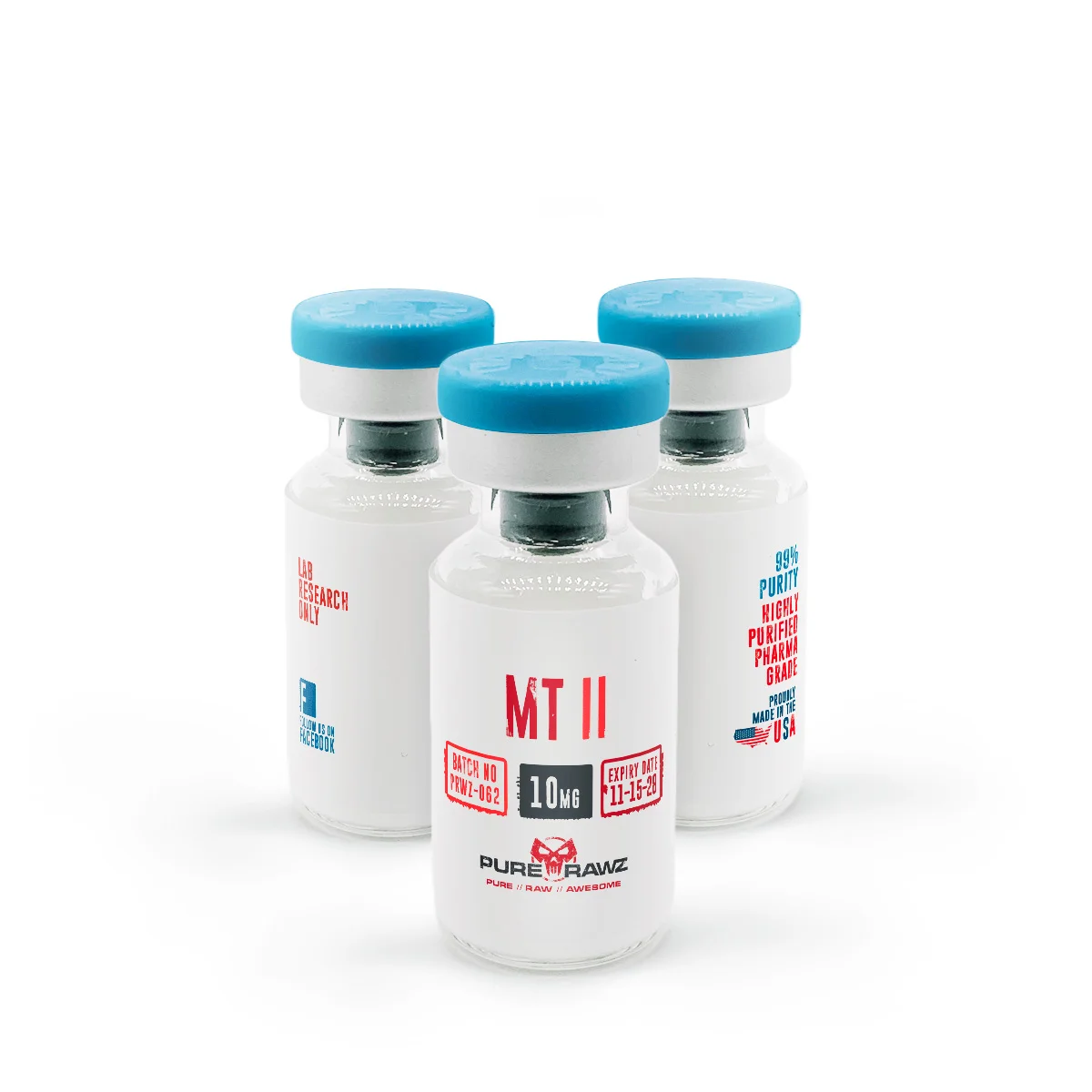
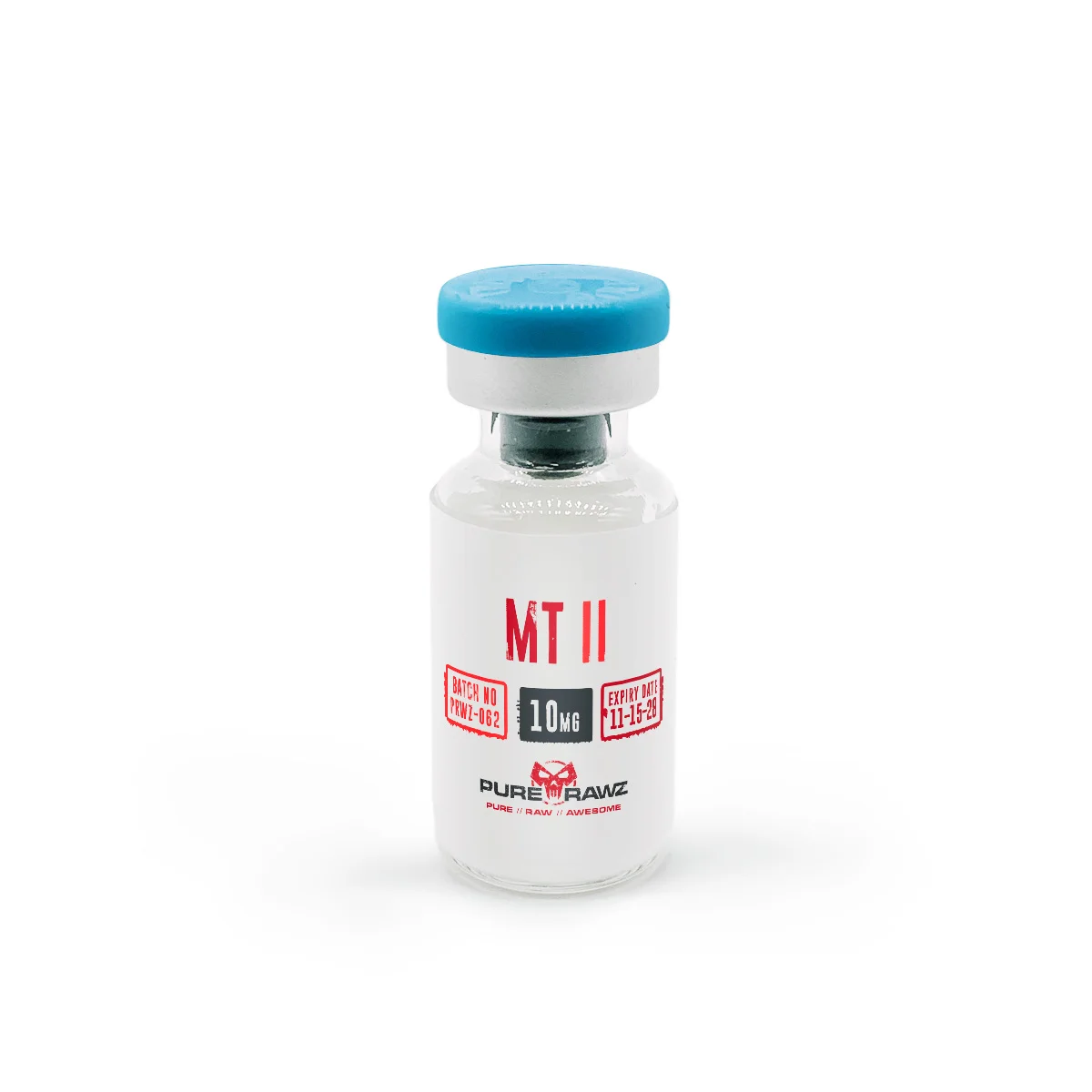
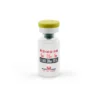
MT-II Overview
MT-II (Melanotan II) is a synthetic peptide that acts as a non-selective agonist of melanocortin receptors and is primarily used in experimental research.
MT-II has also been investigated for its effects on melanocortin receptor-mediated signaling pathways in experimental models.
It is designed to mimic alpha-melanocyte-stimulating hormone (α-MSH) activity. Structural modifications of MT-II were designed to increase stability and binding affinity at melanocortin receptors compared with native α-MSH.
Melanotan II (MT-II) is intended solely for laboratory research and educational purposes and is not for human or veterinary use
What Is Melanotan II?
Melanotan II (MT-II) is a synthetic cyclic analogue of α-melanocyte-stimulating hormone (α-MSH). Researchers commonly use MT-II to investigate melanocortin receptor pharmacology, ligand–receptor interactions, and GPCR signaling in laboratory studies.
Chemical Properties
| PubChem CID | 92432 |
| Molecular Formula | C50H69N15O9 |
| Molecular Weight | 1024.2 g/mol |
| Synonyms | MT-II, Melanotan-II, Melanotan 2… |
| 2D Structure | |
| CAS | 121062-08-6 |
| IUPAC Name | (3S,6S,9R,12S,15S,23S)-15-[[(2S)-2-acetamidohexanoyl]amino]-9-benzyl-6-[3-(diaminomethylideneamino)propyl]-12-(1H-imidazol-5-ylmethyl)-3-(1H-indol-3-ylmethyl)-2,5,8,11,14,17-hexaoxo-1,4,7,10,13,18-hexazacyclotricosane-23-carboxamide |
| Environmental precautions | Do not allow to enter sewers/ surface or ground water. |
| Hazards |
Mechanism of Action of Melanotan II
Melanotan II (MT-II) is a synthetic cyclic analogue of α-melanocyte-stimulating hormone (α-MSH) that functions as a non-selective agonist of the melanocortin receptors MC1R, MC3R, MC4R, and MC5R. In laboratory research, MT-II is widely used to investigate melanocortin receptor pharmacology and G protein-coupled receptor (GPCR) signaling.
Upon binding to melanocortin receptors, MT-II primarily activates Gs protein-dependent signaling, stimulating adenylyl cyclase, increasing intracellular cyclic adenosine monophosphate (cAMP), and activating protein kinase A (PKA). PKA activation can subsequently regulate downstream transcription factors, including cAMP response element-binding protein (CREB). Because signaling responses may vary among melanocortin receptor subtypes and experimental models, MT-II is commonly used to investigate receptor activation, signal transduction, and downstream molecular signaling in controlled laboratory systems.
Experimental Research Applications of Melanotan II
MT-II is studied in controlled laboratory models for the following potential research applications.
-
Melanocortin Receptor Characterization
MT-II is used as a reference agonist in laboratory studies to characterize melanocortin receptor activity, ligand affinity, and receptor selectivity.
-
Structure–Activity Relationship (SAR) Studies
MT-II serves as a model peptide for investigating how structural modifications influence receptor binding, and peptide stability. It supports rational peptide design and melanocortin receptor ligand optimization.
-
Peptide Pharmacology Research
Laboratories use MT-II to examine peptide–receptor interactions, receptor activation characteristics, and ligand potency in controlled experimental systems.
Why Choose PureRawz for MT-II?
At Purerawz, every batch of MT-II is handled with strict quality control to ensure reliability for laboratory research purposes. However, users should independently verify documentation before research use.
All materials are packaged according to laboratory safety standards and shipped in compliance with applicable handling regulations.
FAQs
What Are Melanocortin Receptors (MCRs)?
Melanocortin receptors (MCRs) are a family of G protein-coupled receptors (GPCRs) that mediate cellular responses to melanocortin peptides, including α-melanocyte-stimulating hormone (α-MSH). The receptor family comprises MC1R, MC3R, MC4R, and MC5R, each exhibiting distinct tissue distribution and signaling characteristics. Melanotan II (MT-II) functions as a non-selective agonist of these receptors, making it a valuable research tool for investigating receptor pharmacology, ligand selectivity, and intracellular signaling in experimental systems.
How Is Melanotan II Characterized?
Melanotan II is typically characterized using analytical techniques that verify peptide identity, purity, and molecular composition before laboratory use. Common methods include reverse-phase high-performance liquid chromatography (RP-HPLC) to assess chromatographic purity and liquid chromatography–mass spectrometry (LC-MS) to confirm molecular identity and molecular weight. Researchers may also review peptide sequence verification and batch-specific analytical documentation to support experimental reproducibility.
Why Is Melanotan II a Cyclic Peptide?
Melanotan II was designed as a cyclic peptide analogue of α-MSH to improve structural stability and maintain a defined three-dimensional conformation. Cyclization reduces peptide flexibility and may enhance receptor-binding characteristics while increasing resistance to enzymatic degradation under laboratory conditions. These properties make MT-II a valuable model for peptide chemistry and structure–activity relationship (SAR) research.
What Is α-Melanocyte-Stimulating Hormone (α-MSH)?
α-Melanocyte-stimulating hormone (α-MSH) is an endogenous peptide hormone derived from proopiomelanocortin (POMC). It naturally activates melanocortin receptors and serves as the structural template from which Melanotan II was developed.
How Does Melanotan II Differ from α-MSH?
Melanotan II is a synthetic cyclic analogue of the endogenous peptide α-melanocyte-stimulating hormone (α-MSH). Unlike native α-MSH, MT-II contains structural modifications that improve conformational stability and alter receptor-binding characteristics. These differences have made MT-II a widely used reference compound for investigating melanocortin receptor pharmacology, peptide engineering, and ligand optimization in laboratory research.
Why Is Melanotan II Used as a Reference Agonist?
Melanotan II is frequently used as a reference agonist because its activity at melanocortin receptors has been extensively characterized in receptor pharmacology research. Researchers use MT-II to validate assay performance, compare ligand potency and efficacy, and benchmark newly developed melanocortin receptor agonists under standardized laboratory conditions.
Why Is a Batch-Specific Certificate of Analysis (COA) Important?
A batch-specific Certificate of Analysis (COA) provides analytical information for the exact production lot, including RP-HPLC purity, LC-MS identity confirmation, molecular weight verification, and batch identification. Researchers commonly review the COA before laboratory use.
How Should Melanotan II Be Stored?
For laboratory research, Melanotan II should be stored according to the manufacturer’s specifications and batch-specific documentation. Lyophilized peptide is generally stored in a cool, dry environment protected from light and moisture, while reconstituted material is typically stored under refrigerated conditions for short-term laboratory use. Researchers should minimize repeated freeze–thaw cycles and always follow the storage recommendations provided in the Certificate of Analysis (COA) to help maintain peptide integrity.
Disclaimer
This information is for educational purposes only and not medical advice. Products are for research use only. Research must follow IRB or IACUC guidelines. Verify information independently before purchasing. By ordering, you agree to our Terms and Conditions. If you are not 100% satisfied with the product you received, please contact us at sales@purerawzlab.com
ATTENTION: All our products are for LABORATORY AND RESEARCH PURPOSES ONLY, not for veterinary or human use
Reference Links
- Dorr, R. T., Lines, R., Levine, N., Brooks, C., Xiang, L., Hruby, V. J., & Hadley, M. E. (1996). Evaluation of melanotan-II, a superpotent cyclic melanotropic peptide in a pilot phase-I clinical study. Life Sciences, 58(20), 1777–1784. https://purerawlab.com)00160-9
- McMillan, T. R., Forster, M. A. M., Short, L. I., Rudecki, A. P., Cline, D. L., & Gray, S. L. (2021). Melanotan II, a melanocortin agonist, partially rescues the impaired thermogenic capacity of pituitary adenylate cyclase-activating polypeptide-deficient mice. Experimental Physiology, 106(2), 427–437. https://purerawlab.com
- John, H., Walden, M., Schäfer, S., Genz, S., & Forssmann, W. G. (2004). Analytical procedures for quantification of peptides in pharmaceutical research by liquid chromatography–mass spectrometry. Analytical and Bioanalytical Chemistry, 378(4), 883–897. https://purerawlab.com
- Hruby, V. J., Wilkes, B. C., Hadley, M. E., Al-Obeidi, F., Sawyer, T. K., Staples, D. J., … & de Vaux, A. E. (1995). α-Melanotropin: The minimal active sequence in the frog skin bioassay. Journal of Medicinal Chemistry, 38(17), 3454–3461. https://purerawlab.com
- Mountjoy, K. G. (2010). Functions for pro-opiomelanocortin-derived peptides and melanocortin receptors in obesity and energy homeostasis. Clinical and Experimental Pharmacology and Physiology, 37(7), 692–697. https://purerawlab.com
- Gantz, I., & Fong, T. M. (2003). The melanocortin system. American Journal of Physiology-Endocrinology and Metabolism, 284(3), E468–E474. https://purerawlab.com
- Haskell-Luevano, C., Nikiforovich, G. V., Sharma, S. D., Yang, Y. K., Dickinson, C., Hruby, V. J., & Gantz, I. (1997). Biological and conformational examination of melanotan II, a potent cyclic melanocortin receptor agonist. Journal of Medicinal Chemistry, 40(14), 2133–2139. https://purerawlab.com
| Strength | 10MG |
|---|
Related products
Peptide Unconstituted
Peptides

Peptide Unconstituted
Peptide Blends
Peptide Unconstituted
Peptide Unconstituted

Peptides