
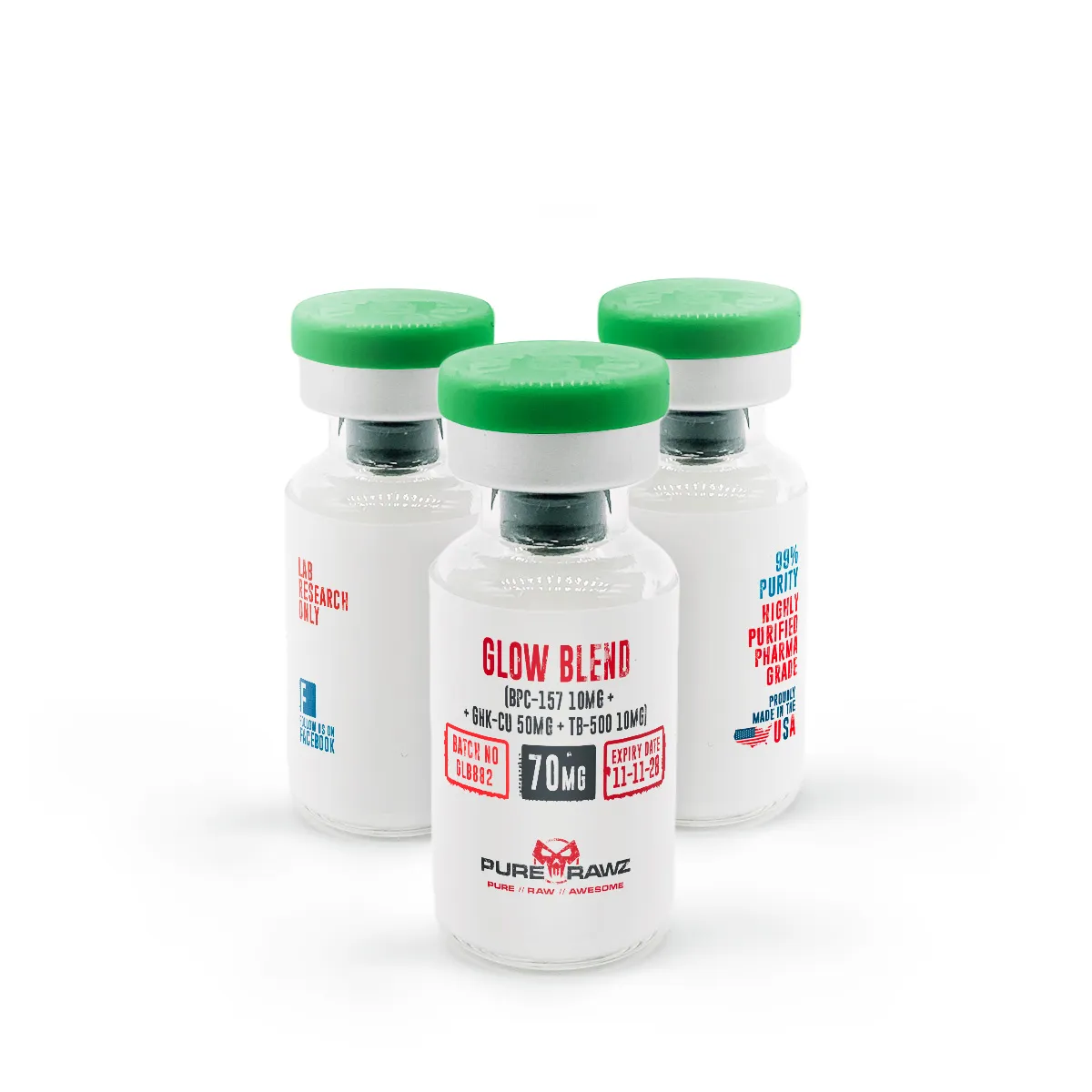
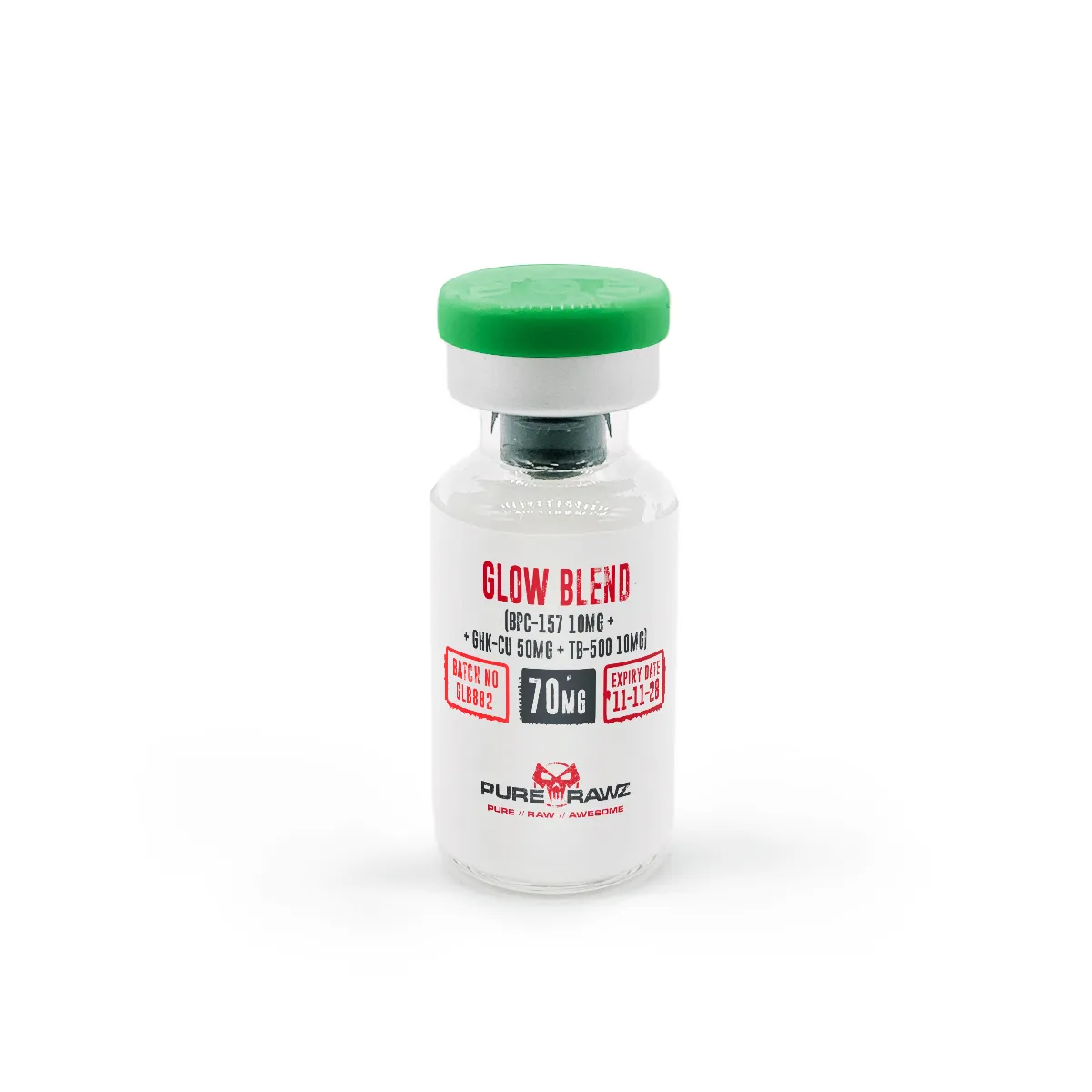
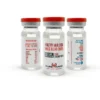
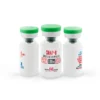
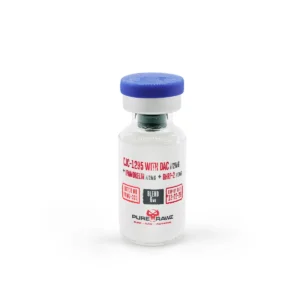
GLOW Blend (BPC-157 + GHK-Cu + TB-500)
$170.00
Note: We recommend using sterile Bacteriostatic Water for reconstitution.
GLOW Blend (BPC-157 + GHK-Cu + TB-500)
GLOW Blend is a co-blended research combination of three synthetic peptides: BPC-157, a pentadecapeptide studied for tissue-repair and cytoprotective activity; GHK-Cu, a copper-chelated tripeptide studied for connective-tissue and matrix-remodeling activity; and TB-500, the full-length Thymosin Beta-4 peptide studied for actin-binding and cytoskeletal activity.
This blend is studied in preclinical research settings for molecular interactions spanning nitric-oxide signaling, copper-dependent matrix remodeling, and cytoskeletal/cell-migration pathways. It is supplied at a nominal 10mg + 50mg + 10mg fill (70mg total per vial).
RESEARCH USE ONLY: This product is intended for laboratory research purposes only. We do not sell this product for human or animal consumption.
Chemical and Molecular Properties
BPC-157
| Property | Value |
| PubChem CID | 9941957 |
| Synonyms | PL 14736, Bepecin |
| Molecular Formula | C62H98N16O22 |
| Molecular Weight | 1,419.56 g/mol |
| CAS | 137525-51-0 |
| Purity | Verify per batch COA (HPLC verified) |
| Physical Form | White lyophilized powder |
| Solubility | Soluble in sterile water or acetic acid |
| Shelf Life | Verify per Certificate of Analysis |
| Classification | Research Use Only (RUO) |
GHK-Cu
| Property | Value |
| PubChem CID | 71587328 |
| Synonyms | Copper Tripeptide-1, Copper Peptide |
| Molecular Formula | C14H21CuN6O4 |
| Molecular Weight | 400.9 g/mol |
| CAS | 89030-95-5 |
| Purity | Verify per batch COA (HPLC verified) |
| Physical Form | White to pale blue lyophilized powder |
| Solubility | Soluble in sterile water |
| Shelf Life | Verify per Certificate of Analysis |
| Classification | Research Use Only (RUO) |
TB-500
| Property | Value |
| PubChem CID | 16132341 |
| Synonyms | Thymosin Beta-4, Timbetasin |
| Molecular Formula | C212H350N56O78S |
| Molecular Weight | 4,963.44 g/mol |
| CAS | 77591-33-4 |
| Purity | Verify per batch COA (HPLC verified) |
| Physical Form | White lyophilized powder |
| Solubility | Soluble in sterile water |
| Shelf Life | Verify per Certificate of Analysis |
| Classification | Research Use Only (RUO); WADA Prohibited S2.3 (Growth Factors), at all times |
Note: “TB-500” sometimes refers in the literature to a shorter 7-amino-acid fragment (CAS 885340-08-9); the properties above describe the full-length sequence commonly supplied under the TB-500 name in the research-peptide trade.
Proposed Working Mechanism of GLOW Blend
Investigational findings indicate that BPC-157 may interact with the nitric oxide (NO) signaling pathway. In preclinical research models, this interaction has been associated with cytoprotective and pro-angiogenic activity relevant to tissue and gastrointestinal repair research.
Research data suggests GHK-Cu’s potential to stimulate collagen, elastin, and glycosaminoglycan synthesis through copper-dependent extracellular-matrix remodeling. This mechanism has been proposed to underlie observations related to connective-tissue research noted across multiple preclinical studies.
Studies conducted in controlled laboratory environments have observed that TB-500 may interact with monomeric actin (G-actin). This interaction is of particular investigational interest in the context of cell-migration and cytoskeletal-signaling research.
Note: GLOW Blend is an investigational compound. It is not approved for clinical use; all mechanistic data are derived exclusively from studies of the individual active components administered separately, not from testing of this specific three-peptide co-blended formulation.
Possible Research Applications of GLOW Blend
This blend combines three synthetic peptides that have gained attention in tissue-repair research for their potential research applications, which include:
Tissue Repair & Cytoprotective Research Preclinical investigations in laboratory models have recorded measurable shifts in tissue and gastrointestinal mucosal integrity metrics, with nitric-oxide-pathway activity documented as a key parameter.
Connective Tissue & Matrix Remodeling Research Investigational studies have yielded quantifiable data on collagen, elastin, and glycosaminoglycan synthesis markers in copper-dependent matrix-remodeling research settings.
Cytoskeletal & Cell-Migration Research Investigational findings have documented modulation of G-actin interaction and cell-migration signaling relevant to cytoskeletal research models.
Combination Repair-Pathway Research Preclinical studies have recorded notable interest in combining these three complementary repair mechanisms cytoprotection, matrix remodeling, and cytoskeletal signaling within a single research framework, though this specific three-way combination has not itself been studied in a published trial.
Research Stability & Handling Profile
GLOW Blend exhibits notable stability characteristics that distinguish it within the peptide research space.
Storage Recommendations for Research Use:
- Store lyophilized GLOW Blend at -20°C or lower in a sealed, desiccated environment
- Once reconstituted for laboratory use, maintain at 2–8°C and utilize within established research protocol timeframes
- Avoid repeated freeze-thaw cycles to preserve peptide integrity for research purposes
- Keep away from UV light exposure during storage
- For reconstitution, use sterile bacteriostatic water. Do not use saline.
Risk & Handling
- GLOW Blend is intended for research purposes only and should be handled by trained professionals using appropriate laboratory procedures and safety protocols.
- Due to limited clinical data on this specific three-peptide combination, the full safety profile, potential adverse effects, and long-term implications remain under investigation.
- Researchers should avoid direct exposure through inhalation, ingestion, or skin contact and use suitable protective equipment (gloves, respirator, eye protection) during handling.
- Materials should be stored in a cool, dry, and controlled environment away from heat, moisture, and direct sunlight to maintain stability and integrity.
- All preparation and handling equipment should be sterile and properly maintained to reduce the risk of contamination or compromised results.
- GLOW Blend should not be marketed or represented as an approved treatment, cure, or preventive solution for any medical condition without regulatory authorization.
- Proper documentation, labeling, and disposal procedures should be followed in accordance with institutional, local, and national regulations.
- Individuals with underlying medical conditions, those taking medications, or anyone considering experimental applications should seek guidance from qualified healthcare or research professionals.
- TB-500 is prohibited at all times under the WADA Prohibited List (S2.3, Growth Factors); tested athletes should not handle or use this product.
PureRawz Quality & Purity Standards
PureRawz is committed to supplying the USA research community with the highest-integrity investigational compounds available. Every batch of GLOW Blend is confirmed by independent third-party HPLC analysis, with a Certificate of Analysis (COA) available per lot.
Note: GLOW Blend is an investigational compound and has not been established as safe or effective for any therapeutic use in this specific co-blended form.
Frequently Asked Questions
Is it legal to buy GLOW Blend in the US?
Yes. It’s sold as a research chemical, not a drug, so ordering it for lab use is legal.
Do I need any kind of permit to order this?
No permit is needed to buy it, but only trained lab people should actually handle or use it.
How many peptides are in one vial?
Three BPC-157, GHK-Cu, and TB-500 mixed together, totaling 70mg.
Has this exact three-peptide mix been tested together?
No. Each one has its own research on its own, but not this specific combo as one product.
What’s this blend generally used for in research?
Mostly tissue repair each peptide helps in a different way, from protecting tissue to healing connective tissue to helping cells move.
How should I store this once it shows up?
Keep it frozen at -20°C, away from light. Once mixed with water, put it in the fridge and use it soon.
Is this safe to work with?
It hasn’t been fully tested for safety as a combo, so treat it carefully and follow lab safety steps.
Can athletes use TB-500 without an issue?
No. TB-500 is banned by name on the World Anti-Doping Agency’s list, no exceptions.
Disclaimer
This information is for educational purposes only and not medical advice. Products are for research use only. Research must follow IRB or IACUC guidelines. Verify information independently before purchasing. By ordering, you agree to our Terms and Conditions. If you are not 100% satisfied with the product you received, please contact us at support@purerawz.co.
ATTENTION: All our products are for LABORATORY AND RESEARCH PURPOSES ONLY, not for veterinary or human use.
Reference Links
- Sikiric, P., Seiwerth, S., Rucman, R., et al. (2014). Stable gastric pentadecapeptide BPC 157-NO-system relation. Current Pharmaceutical Design, 20(7), 1126–1135. PMID: 23755725. https://pubmed.ncbi.nlm.nih.gov/23755725/
- Pickart, L., & Margolina, A. (2018). Regenerative and Protective Actions of the GHK-Cu Peptide in the Light of the New Gene Data. International Journal of Molecular Sciences, 19(7), 1987. PMID: 29986520. https://pubmed.ncbi.nlm.nih.gov/29986520/
- Maquart, F. X., Bellon, G., Chaqour, B., et al. (1993). In vivo stimulation of connective tissue accumulation by the tripeptide-copper complex glycyl-L-histidyl-L-lysine-Cu2+ in rat experimental wounds. Journal of Clinical Investigation, 92(5), 2368–2376. PMID: 8227353. https://pubmed.ncbi.nlm.nih.gov/8227353/
- Goldstein, A. L., Hannappel, E., Sosne, G., & Kleinman, H. K. (2012). Thymosin β4: a multi-functional regenerative peptide. Basic properties and clinical applications. Expert Opinion on Biological Therapy, 12(1), 37–51. PMID: 22074294. https://pubmed.ncbi.nlm.nih.gov/22074294/
- National Center for Biotechnology Information (NCBI). BPC-157, PubChem CID 9941957. National Institutes of Health. https://pubchem.ncbi.nlm.nih.gov/compound/9941957
- National Center for Biotechnology Information (NCBI). GHK-Cu, PubChem CID 71587328. National Institutes of Health. https://pubchem.ncbi.nlm.nih.gov/compound/71587328
- National Center for Biotechnology Information (NCBI). Thymosin Beta-4 (TB-500), PubChem CID 16132341. National Institutes of Health. https://pubchem.ncbi.nlm.nih.gov/compound/16132341
- U.S. Food and Drug Administration. Pharmacy Compounding Advisory Committee (PCAC) Meeting Materials, July 2026 review of BPC-157 and related bulk drug substance nominations. https://www.fda.gov/advisory-committees/pharmacy-compounding-advisory-committee
- World Anti-Doping Agency. The 2026 Prohibited List International Standard, Section S2.3 (Growth Factors, Growth Factor Modulators and Related Substances). https://www.wada-ama.org/en/prohibited-list
| Form | Peptides |
|---|---|
| Dose | 70mg |
Related products
Peptide Unconstituted
Peptides
Peptides
Peptides
Peptides
Peptides

Peptides