
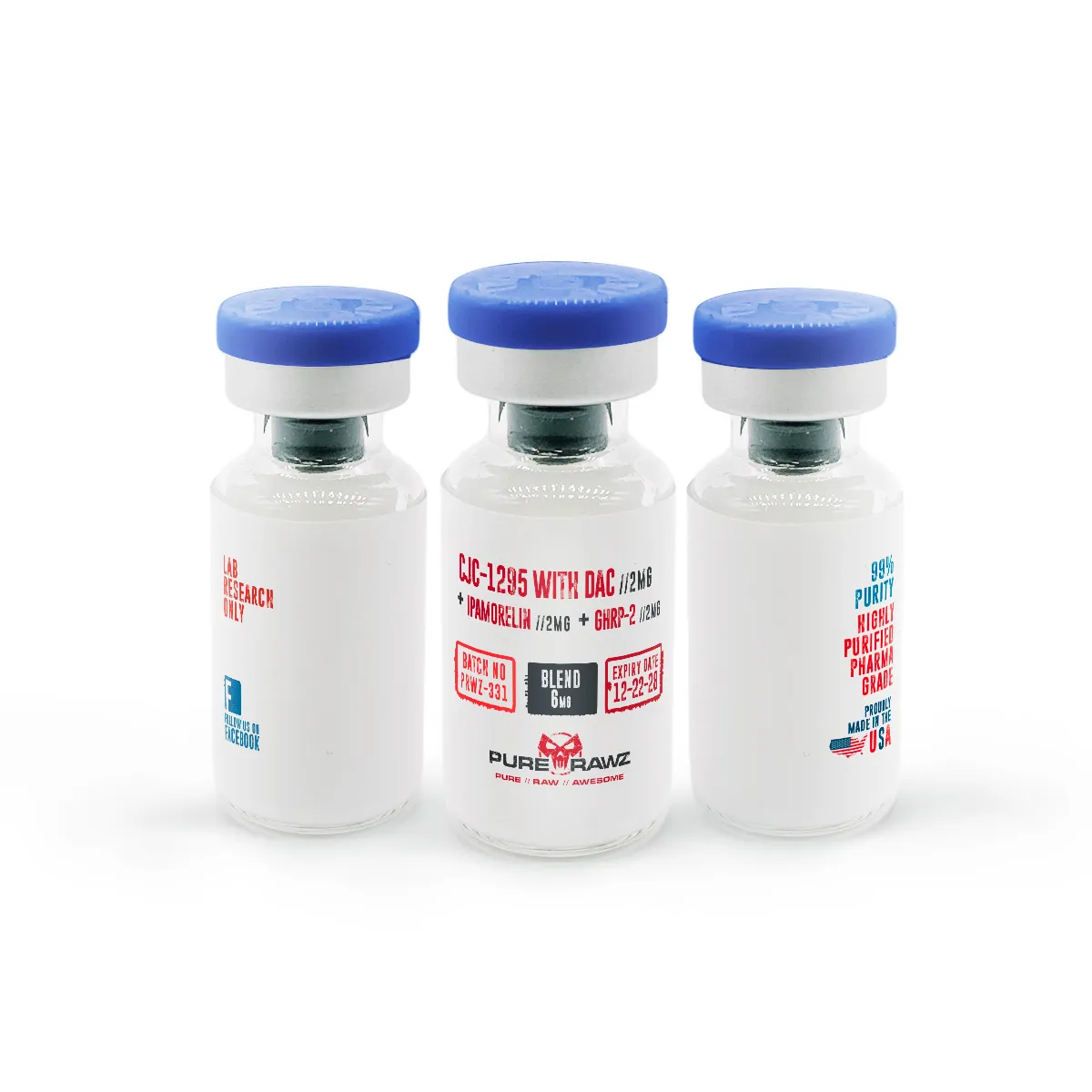
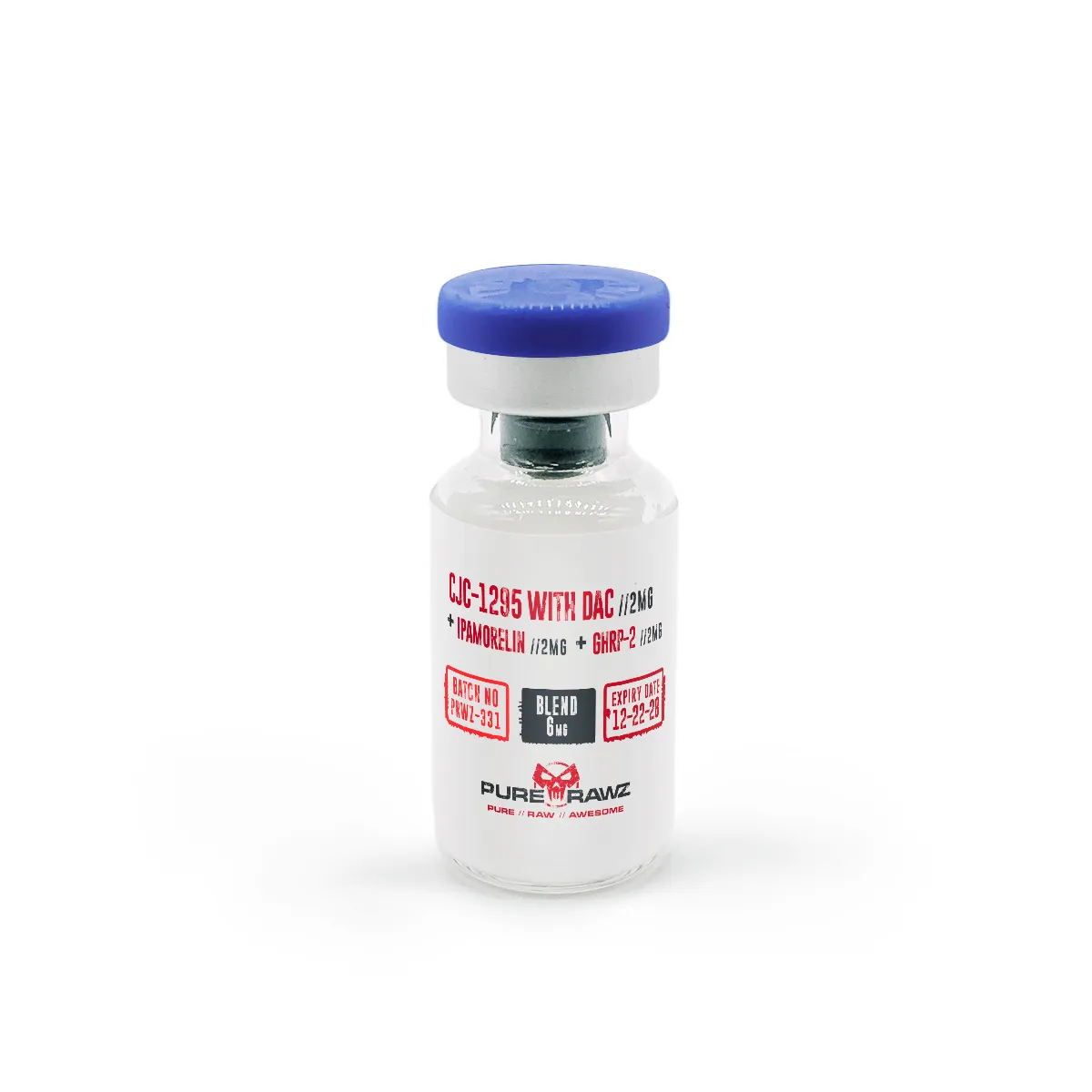
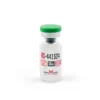
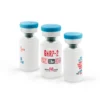
CJC-1295 DAC + Ipamorelin + GHRP-2 Triple Blend (6mg)
$82.10
Note: We recommend using sterile Bacteriostatic Water for reconstitution.
Overview
CJC-1295 DAC + Ipamorelin + GHRP-2 Triple Blend (6mg) is a three-component GH secretagogue research formulation co-formulating 2mg each of CJC-1295 with Drug Affinity Complex (DAC), ipamorelin, and GHRP-2. Each peptide activates the GH axis through a mechanistically distinct receptor: CJC-1295 DAC activates the GHRH receptor (GHRHR) on anterior pituitary somatotrophs via Gs/cAMP/PKA signalling; ipamorelin and GHRP-2 both activate GHS-R1a (ghrelin receptor) via Gq/PLCβ/IP3/Ca²⁺ signalling — but with different selectivity profiles (ipamorelin is selective for GH without ACTH/cortisol; GHRP-2 co-stimulates ACTH and cortisol). This triple-mechanism formulation combines GHRHR activation with dual GHS-R1a input in a single research reagent. All three peptides are classified under WADA S2.2.4 (Growth Hormone-Releasing Peptides and their mimetics). None is FDA-approved. Supplied for laboratory research only.
Chemical Properties
| Property | Details |
| Product Format | Triple-peptide research blend | Lyophilized powder | 6mg per vial |
| Compound Class | GH Secretagogue Peptide Blend | NOT SARMs |
| Component 1 | CJC-1295 with DAC (DAC:GRF) | CAS 863288-34-0 | 2mg | MW ~3367 Da + albumin conjugation |
| Component 2 | Ipamorelin (NNC 26-0161) | CAS 170851-70-4 | 2mg | MW 711.8 Da |
| Component 3 | GHRP-2 (Pralmorelin) | CAS 158861-67-7 | 2 mg | MW 825.9 Da |
| Peptide Class | GHRHR agonist (CJC-1295 DAC) + GHS-R1a agonists (Ipamorelin + GHRP-2) |
| Physical Form | Lyophilized powder |
| Purity | ≥98% per component (HPLC verified) |
| Storage | Store at −20°C, sealed, protected from light and moisture |
| WADA Classification | All three: WADA S2.2.4 — Growth Hormone-Releasing Peptides (prohibited in- and out-of-competition) |
| Classification | Research Use Only (RUO) |
Mechanisms Investigated in Preclinical Research
CJC-1295 DAC → GHRHR/Gs/cAMP/PKA (Extended Half-Life GHRH Agonist): CJC-1295 DAC incorporates a Drug Affinity Complex (DAC) lysine modification — a maleimidopropionamide derivative — that covalently binds plasma albumin after reconstitution, extending half-life from minutes (native GHRH) to approximately 6–8 days in preclinical pharmacokinetic models (Jetté et al. 2005, Endocrinology, PMID 15817669). At the receptor level, CJC-1295 DAC binds GHRHR on anterior pituitary somatotrophs, activating Gs → adenylyl cyclase → cAMP → PKA → GH gene transcription and pulsatile GH exocytosis. The extended half-life produces sustained but pulsatility-preserving GHRHR occupation, in contrast to continuous GHRH infusion, which produces receptor desensitisation.
Ipamorelin → GHS-R1a/Gq/PLC/Ca²⁺ (Selective — No ACTH/Cortisol): Ipamorelin is the first documented selective GHS-R1a agonist (Raun et al. 1998, PMID 9849822). It activates GHS-R1a via Gq/11 → PLCβ → IP3 → Ca²⁺ release from somatotroph ER, producing pulsatile GH exocytosis without co-stimulating ACTH, cortisol, prolactin, FSH, LH, or TSH even at doses 200-fold above the GH-releasing ED50. In the context of this triple blend, ipamorelin provides the GHS-R1a component without adrenal confound.
GHRP-2 → GHS-R1a/Gq/PLC/Ca²⁺ + ACTH/CRH Co-Stimulation: GHRP-2 activates GHS-R1a via an identical Gq/PLCβ/Ca²⁺ cascade as ipamorelin but is non-selective — co-stimulating ACTH and cortisol release (Muccioli et al. 2007, PMID 17622734). In this triple blend, GHRP-2’s non-selective GHS-R1a profile is the mechanistic contrast to ipamorelin’s selectivity, enabling comparative GHS-R1a pathway research within the same experimental system.
Triple-Receptor Synergy: GHRHR + GHS-R1a (dual): CJC-1295 DAC (GHRHR) and ipamorelin/GHRP-2 (GHS-R1a) activate non-overlapping receptor systems with different intracellular signalling cascades (Gs/cAMP vs Gq/Ca²⁺) that converge on GH exocytosis from the same somatotroph. This receptor pathway complementarity is the mechanistic basis for synergistic GH release documented in preclinical models when GHRH analogues and GHRPs are co-administered.
Research Applications
- Triple-pathway GH axis pharmacology: GHRHR + GHS-R1a dual input GH release kinetics in primary anterior pituitary somatotroph models and GHS-R1a/GHRHR co-transfected cell systems
- Ipamorelin vs GHRP-2 selectivity comparison within the same GH axis experimental system: quantifying ACTH/cortisol co-stimulation attributable to GHRP-2 (vs ipamorelin) GHS-R1a agonism in primary pituitary cultures
- CJC-1295 DAC DAC-albumin bioconjugation pharmacokinetics research: GHRHR binding duration, receptor occupancy modelling, and sustained vs pulsatile GH secretory profile investigation
- Synergistic receptor pathway GH pulse amplitude research: characterisation of convergent Gs/cAMP + Gq/Ca²⁺ somatotroph signalling as a function of relative GHRHR and GHS-R1a occupancy
- GH secretagogue SAR studies: GHRP-2 vs ipamorelin comparative receptor pharmacology within a fixed-ratio blend — isolating the contribution of D-β-naphthylalanine vs D-2-naphthylalanine structural differences to GHS-R1a selectivity profile
Risk & Handling
Handling Precautions
- Trained laboratory personnel only in a controlled laboratory environment. PPE: nitrile gloves, laboratory coat, eye protection minimum
- Reconstitute under aseptic conditions with sterile water or bacteriostatic water. Handle as CNS-active neuroendocrine research peptides
- All three components are GH axis secretagogues. Institutional biosafety review is strongly recommended before initiating any research programme involving this blend
Exposure Risks
- Risk Tier: CRITICAL/HIGHEST — All three components are GH secretagogues classified under WADA S2.2.4. This triple-peptide blend carries HIGHEST regulatory exposure: (1) three concurrent GH axis-active peptides; (2) GHRP-2 co-stimulates ACTH/cortisol, adding adrenal axis activation; (3) CJC-1295 DAC’s extended half-life (~6–8 days) produces prolonged GHRHR occupancy in biological systems. The Anti-Drug Abuse Act context applies to GH secretagogue compounds. No human safety data has been established for this specific triple-peptide research blend. No long-term toxicity data exist for any component. Dependency or abuse potential via the GH axis is mechanistically plausible but uncharacterised. Legal counsel is recommended for institutional research programmes involving WADA-prohibited GH secretagogue compounds.
Storage
- Store at −20°C sealed, light-protected, and dry. Reconstitute with bacteriostatic water under aseptic conditions. Do not refreeze reconstituted solution. Stable ≥24 months lyophilized.
Quality Assurance
- Identity confirmation by nuclear magnetic resonance (NMR) spectroscopy and/or mass spectrometry (MS)
- Purity ≥98% by high-performance liquid chromatography (HPLC)
- Moisture content tested per USP standards where applicable
- Microbial testing for aerobic bacteria, yeast, and mould per USP <61> and <62>
- Heavy metals analysis (Pb, Cd, As, Hg) per USP <232>/<233> standards
- Full batch traceability with unique lot number documentation
- Certificate of Analysis (COA) available upon request for every batch
- Safety Data Sheet (SDS) available for all products
Why PureRawz
PureRawz supplies CJC-1295 DAC + Ipamorelin + GHRP-2 Triple Blend as a rigorously tested research-grade compound. Each batch undergoes independent third-party identity confirmation by NMR and HPLC, with purity ≥98% verified. Where supplier specifications for complex blends or novel fusion compounds vary across vendors, PureRawz applies batch-specific molecular identity confirmation to verify component presence and ratio accuracy. A Certificate of Analysis (COA) documenting identity, purity, and lot traceability is available for every batch. A Safety Data Sheet (SDS) is provided for all products. Researchers requiring absolute certainty on batch composition for publication-quality study design should request COA documentation before initiating protocols.
References
- Jetté L, Léger R, Thibaudeau K, et al. Human growth hormone-releasing factor (hGRF)1−29-albumin bioconjugates activate the GRF receptor on the anterior pituitary in rats: identification of CJC-1295 as a long-lasting GRF analog. Endocrinology. 2005;146(7):3052–3058. https://pubmed.ncbi.nlm.nih.gov/15817669/ [PMID 15817669]
- Raun K, Hansen BS, Johansen NL, et al. Ipamorelin, the first selective growth hormone secretagogue. European Journal of Endocrinology. 1998;139(5):552–561. https://pubmed.ncbi.nlm.nih.gov/9849822/ [PMID 9849822]
Enhanced Legal Notice — GH Secretagogue Triple Blend / WADA S2.2.4 All Three Components: This product is a research chemical for laboratory use only. NOT approved by the FDA for human use and prohibited for human consumption or injection. Compounds that interact with the growth hormone axis or GLP-1 receptor systems carry significantly elevated regulatory exposure. Supplied strictly for in vitro bioassay and preclinical model research only. Unauthorized human use or distribution may violate federal law, including the Anti-Drug Abuse Act. Purchaser assumes all liability for federal and state law compliance.
Disclaimer: Preclinical and published scientific research indicates potential mechanisms of action for this compound in laboratory and animal models. Any references to published studies are for informational purposes only and do not constitute a claim that this product produces the same effects in humans. The safety and efficacy of this compound in humans have not been established.
ATTENTION: All products sold by PureRawz are intended for laboratory and research purposes only and are not approved for human consumption, veterinary use, or any other use. Products are not evaluated by the FDA and are not intended to diagnose, treat, cure, or prevent any disease. Customers assume full responsibility for the lawful use of these products in accordance with all applicable federal, state, and local regulations.
| Form | Peptides |
|---|---|
| Dose | 6mg |
Related products
Peptides
Peptides
Peptides
Peptides
Peptides
Peptide Unconstituted
Peptides